1849

The Hill Finds Its Name
A wooden semaphore on the summit signaled the arrival of ships through the Golden Gate. That “telegraph” gave the hill its enduring name.
1849
A wooden semaphore on the summit signaled the arrival of ships through the Golden Gate. That “telegraph” gave the hill its enduring name.
1849
A wooden semaphore on the summit signaled the arrival of ships through the Golden Gate. That “telegraph” gave the hill its enduring name.
1882
Frederick O. Layman opened a restaurant, observatory, and wooden “German Castle” near the summit. Reached by a short lived cable car funded by Adolph Sutro, it soon became known as Layman’s Folly.
1903
Fire gutted Layman’s weathered castle in 1903. The attraction was gone, but the image of a castle above the bay remained part of Telegraph Hill’s imagination.
1923
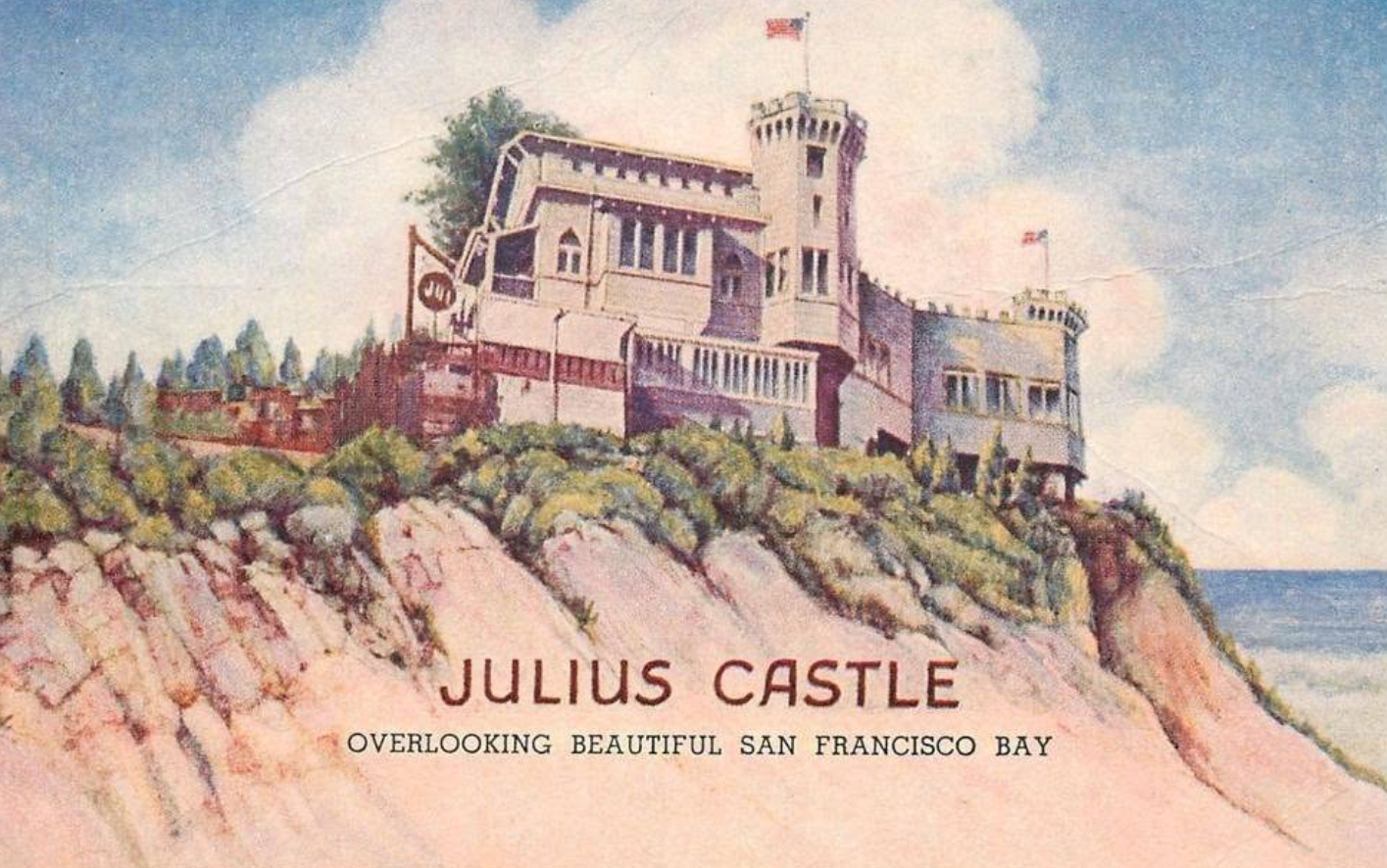
Julius Roz and architect Louis Mastropasqua shaped a singular mix of Gothic Revival, Arts and Crafts, and fairytale battlements.
1928
Quickly beloved by San Franciscans and critics alike, Julius expanded the castle in 1928 to accommodate more guests.
1928–1931
Local histories report that a turntable was installed at Montgomery Street’s narrow dead end in the 20’s, where an attendant physically rotated patrons’ cars.
1943
Julius Roz passed away after nearly two decades as the Castle’s chef and maître d’. The restaurant passed through new hands while keeping his name, its distinctive rooms, and its view.
1950–1951
Hollywood wrapped the restaurant in a temporary mansion façade for The House on Telegraph Hill. It also appears in The Raging Tide.
1980
Landmark status took effect in 1980. Jeffrey Pollack purchased Julius Castle that year and operated it for twenty-six years.
2007
A tenant-run reopening lasted roughly six months. By late 2007 the restaurant was vacant, beginning a closure of nearly nineteen years.
2012–2026
Paul Scott purchased the property in 2012. The long restoration overcame unpermitted alterations, fire damage, hillside movement, numerous public hearings, accessibility challenges, deferred maintenance, litigation, and pandemic delays.
November 12, 2026
Julius Castle welcomes diners back to Telegraph Hill, beginning a new chapter more than a century after Julius Roz opened his rooms above the bay.
The sight is Telegraph Hill — one of the seven noble hills of this proud city. The name dates back to 1849, in the Gold Rush days, when a telegraph semaphore system connected to Point Lobos, seven miles south, signaled the coming of inbound ships off the Golden Gate, and when citizens poured out to climb the hill and welcome new arrivals to our fair City by the Bay.
In post-Gold Rush years, the hill became the domain of Irish emigrants, who set up their shanties and strung their wind-whipped wash, while goat herds lazed and grazed on the slopes around them. By 1920, the hill had become a veritable Bohemian art colony and the young artists and writers of the day dreamed of building a Greenwich Village West — but it wasn’t to be.
Telegraph Hill began to grow, and proud homes rose on the sites of sagging shanties. Frederick Layman built a Castle at the top of the hill in 1882, only to see it fall into disrepair and burn to the ground in 1903. No doubt inspired by Layman's folly, Julius Roz, a former restaurant counterman and Italian immigrant, turned the first spadeful of soil for his castle on the hill in 1920. Employing skilled craftsmen and using the finest materials - rich redwoods and elegant maples from the Pan Pacific Exposition - Roz built an entirely unique and magnificent castle above the Bay, known around the world as Julius Castle.
In the twenties, the Castle became as a favored gathering place for San Francisco's well-heeled. The local elite were drawn to Julius' fine cuisine, and it was a popular speakeasy for the carriage trade during Prohibition. Meanwhile, from its decks and windows, patrons enjoyed the slow-motion water ballet of ferries, including steamboat paddle-wheelers, traversing the bay, with soft white wakes fading into the blue waters astern and an escort of seagulls trailing above.
Through the years, the golden pages of San Francisco history have continued to turn outside the Castle's windows: the start of the Bay Bridge in 1933. Completed—1936. Low, to the North, the man-made Treasure Island, dredged from the bottom of the bay for the 1939 World’s Fair.
During World War II, the diners at Julius Castle saw the passing gray parade of battle wagons, carriers, destroyers, and troop ships come and go. In contrast to the heavyweights, the ferries continued their daily runs in the shadow of the giant bridge. The ferries retired in 1958, a tradition passed on. But in the late ’60s they returned—a new breed of boat—smaller and faster to serve the mushrooming suburbs of Marin County to the North.
All the while, the castle aged and mellowed gracefully as a part of San Francisco. Out of the way, it was—but people went out of their way to find it. The food? Consistently superb—cooked with contemporary verve and laced with subtle accents of Julius Roz’s Italian roots. The wines? Distinguished. And the service? An efficient blend of quiet elegance and warmth. The Castle is a euphoric place, where one is wont to linger. And the view? Unrivaled in a city of unparalleled beauty. The view from the top of the stairs? Straight ahead—North. Slightly West, Alcatraz Island, the former Federal prison. Eastward along the distant shoreline: the Richmond-San Rafael Bridge and Red Rock Island, squatting in the North Bay like some giant turtle. Following down the East Shore—Richmond, El Cerrito, Albany, Berkeley, Emeryville, Oakland and Alameda—and the South Bay Area. This is the spreading tapestry of land and sky and water as seen from the castle. By day? Shimmering in sunlight or wrapped in rolling fog—or basking in the warm and rosy glow of evening. And by night? A brilliant, twinkling mosaic of multicolored lights on black velvet. Day or night—no matter. The enchanting atmosphere, gracious service, fine cuisine, distinguished wines, and extraordinary views have indeed made Julius Castle a legend in its own time.
In 1980, Julius Castle was designated as a Historic Landmark, and over the last decade plus has undergone a meticulous restoration, preserving its historic charm and updating its facilities to serve exceptional cuisine for our latest generation of guests. Today, we invite you to step inside our magical Castle, leave the everyday world behind, and embark on a journey into another time that you will never forget.